BlogAnki how-to
Cloze vs basic in Anki: when to use each
Basic for a clear question, cloze for facts inside a sentence or list, image occlusion for diagrams. With examples of each.
Omar··6 min read
Use basic when there’s a clear question with one short answer. Use cloze when the fact lives inside a sentence or a list. Use image occlusion for diagrams. Most good decks mix all three; the mistake is forcing everything into one type.
The card types Anki ships with
Anki’s manual lists six built-in note types. Four are versions of basic (front and back, with or without a reversed card or a box to type the answer), one is cloze, and one is image occlusion, which works like cloze but on a picture.
When basic wins
Basic is best when the fact is a question you could ask out loud, with one short answer.
| Front | Back |
|---|---|
| Which enzyme catalyses the committed step of glycolysis? | Phosphofructokinase-1 |
| What does the ‘-pril’ ending tell you about a drug? | It’s an ACE inhibitor |
| Spanish for “to remember”? | recordar |
For pairs you need both ways (a word and its meaning, a drug and its class), use “Basic (and reversed card)”: one note, two cards.
When cloze wins
Cloze is best when the fact only makes sense inside its sentence, or when you need to learn a list. You keep the context and hide the part that matters.
- Glycolysis takes place in the {{c1::cytoplasm}}.
- Negatively charged side chains: {{c1::aspartate}} and {{c2::glutamate}}.
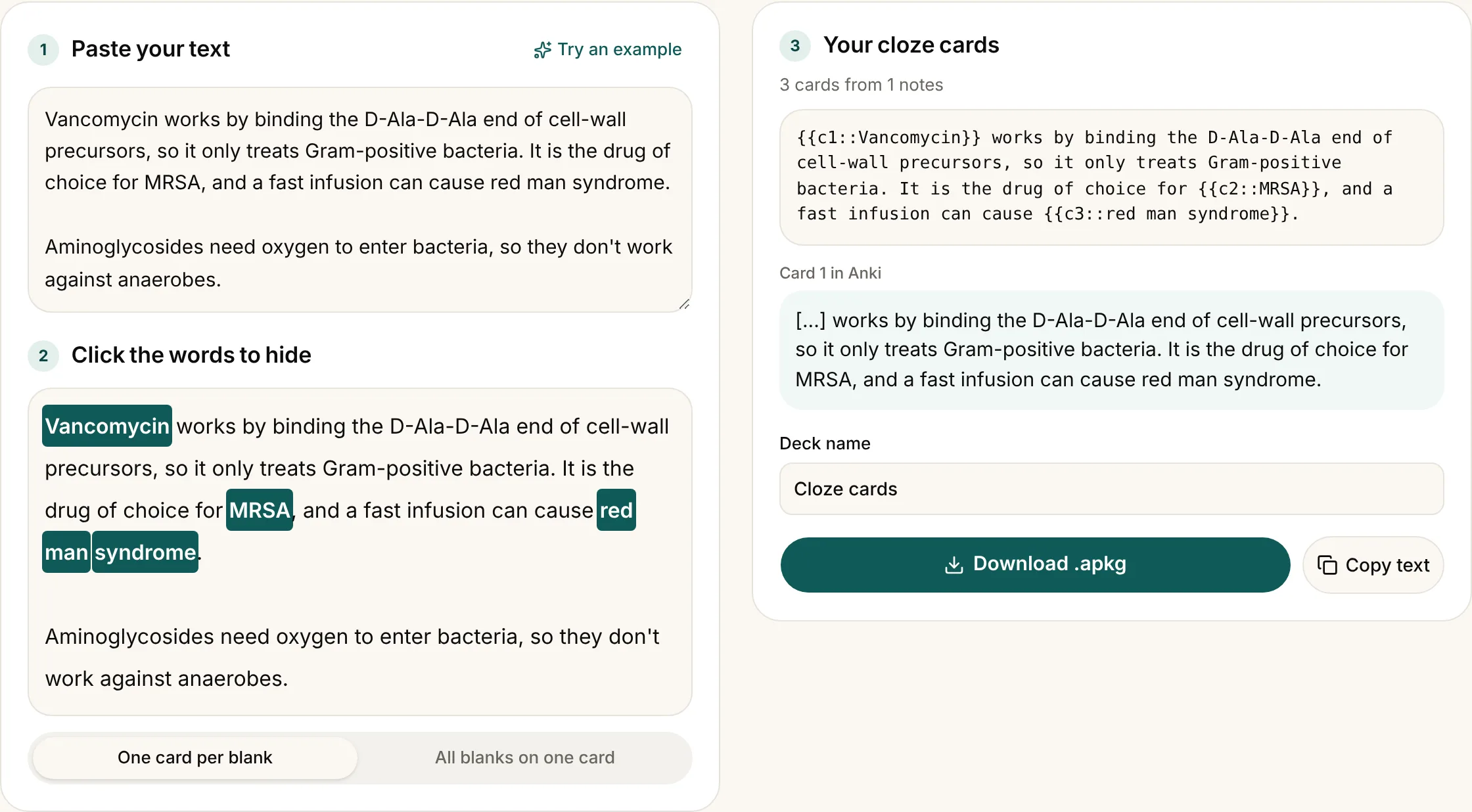
Each number is its own card: c1 and c2 make two cards, two c1s hide both on one card. Hold Alt (Option on a Mac) while you make a cloze to reuse the number (manual). For long lists, one number per item is usually better than hiding the whole list at once.
Cloze mistakes that waste reviews
- Hiding an easy word, so the card tests grammar, not knowledge.
- Hiding half the sentence, so there’s nothing left to cue the answer.
- Ten clozes in one note, all numbered c1: one card nobody can answer.
- Copying whole paragraphs from slides and clozing a word in each.
To get the numbering right without typing the brackets, paste a sentence into the free cloze maker and click the words to hide.
Most of my own cards are cloze. The habit I dropped was huge cards with too much text on them. I split those into smaller cards now.
Diagrams: neither
For anything you learn by looking (anatomy, pathways, histology), use image occlusion: hide the labels on the picture and test yourself on each one. It’s built into Anki since 23.10. Here’s how to use it, step by step.
Rule of thumb: if you’d point at it, image occlusion. If you’d say it, basic. If you’d fill in the blank, cloze.
Get the right card type for every fact
AnkiDecks makes basic, cloze and image occlusion cards from your slides or notes, picking the type per fact, with the line and page each one came from. The free plan makes 3 decks a month (up to 15 pages each).
Make cards from your notesFree to try · No credit card needed
Questions
- What’s the difference between c1 and c2?
- Each number is its own card. {{c1::A}} and {{c2::B}} make two cards; {{c1::A}} and {{c1::B}} hide both on one card. Hold Alt (Option on a Mac) while making a cloze to reuse the same number.
- When should I use “Basic (and reversed card)”?
- When you need both directions, like a term and its definition, or a drug and its class. Anki makes two cards from one note: front to back and back to front.
- Can one note be both basic and cloze?
- No, each note has one type. Pick the type per fact, not per deck.